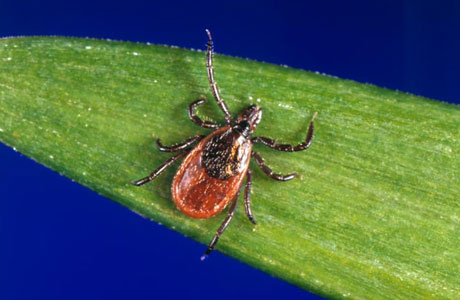
A nearly sevenfold increase in deer tick sightings across suburban Cook County this spring has public health officials urging families to take precautions at any trail, field, or green space through September.
The spike was recorded by the Northwest Mosquito Abatement District, which covers northwest Cook County. Patrick Irwin, the district's entomologist and assistant director, told the Chicago Tribune that climate change is letting ticks "survive better and get active earlier than what we would usually see."
Ticks aren't just a camping problem anymore.
"It's not true that ticks are only something you're going to encounter on a camping trip," said Dr. Kelly Cairns, president of the Chicago Veterinary Medical Association. "Ticks don't recognize city limits."
What triggered the surge
February, March, and April 2026 all ran above average in temperature, allowing ticks to emerge from dormancy weeks earlier than normal. Snow cover during cold snaps insulated ticks from lethal temperatures, helping more survive into spring. On June 1, the Northwest Mosquito Abatement District issued a formal alert warning that nymphal deer ticks are now being found in residential neighborhoods across its service area. Nymphs are about the size of a poppy seed, making them nearly impossible to spot during a standard body check. They still transmit Lyme disease.
The Illinois Department of Public Health reports roughly 300 confirmed Lyme disease cases per year statewide, though many more likely go unreported because early symptoms mimic the flu. Nationally, the CDC reported that emergency room visits for tick bites in April 2026 hit their highest rate for that time of year since 2017.
What this means for the North Shore
The North Shore Mosquito Abatement District, headquartered at 117 Northfield Road in Northfield, serves Wilmette, Winnetka, Glencoe, Kenilworth, and Northfield. The district operates a tick surveillance program and a Tick ID Lab where residents can submit ticks for identification. No North Shore-specific tick advisory has been issued for 2026, but the same ecological conditions driving the suburban surge apply to local green spaces, including the Skokie Lagoons trail system, Gillson Park, the North Branch Trail, and park district athletic fields where youth soccer, lacrosse, and cross-country teams train through the summer.
How to protect your family
Public health guidance for athletes and families is straightforward: wear light-colored clothing, tuck pants into socks, use EPA-registered repellent with DEET or picaridin, and perform full-body tick checks after every outdoor session.
Dr. Ihab Ahmed, an infectious disease physician at Northwestern Medicine, put it simply: "It's not fashionable, but the best way to not get bit is to kind of look like a dork."
Pet owners should also be alert. Dr. Cairns urged anyone whose dog has had a tick to call their vet immediately rather than wait.
Tick season runs through September. Residents can check nsmad.org for weekly surveillance reports and submit ticks to the district's ID Lab for identification.