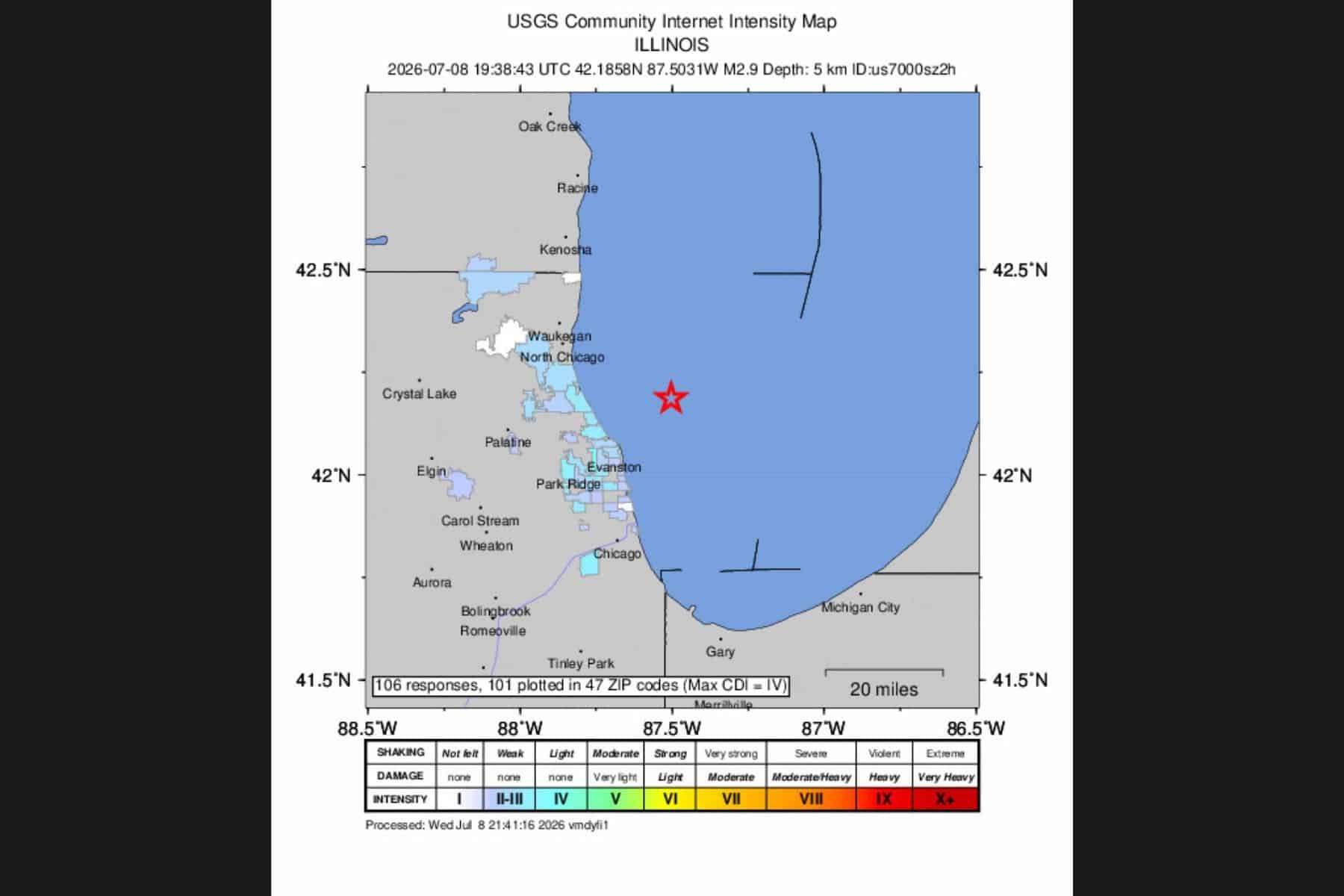
Residents along the Kenilworth lakefront, in Wilmette near Gillson Park, and across Glencoe felt the ground shake Wednesday afternoon, July 8, when a 2.9 magnitude earthquake struck beneath Lake Michigan about 12 miles off the North Shore coastline.
The quake hit at approximately 2:38 p.m. and registered 3.1 miles (about 5 kilometers) below the lake's surface, according to the U.S. Geological Survey (event ID: us7000sz2h). More than 400 people filed reports through the USGS "Did You Feel It?" program, with the largest clusters coming from Evanston (59 reports), Highland Park (37), Wilmette (16), Skokie (16), Glencoe (12) and Kenilworth (4).
No damage was reported, and no North Shore village issued an emergency management advisory. Area village halls and police departments said they received no calls or complaints related to the quake, according to CBS News Chicago.
In neighboring Evanston, which logged the most USGS reports at 59, resident Stephen Lewis was working on the third floor of his home when he felt the rumble. His husband, in the basement, noticed nothing.
Why earthquakes happen here
Tom Skilling, the longtime Chicagoland meteorologist, explained in a Facebook post that no major fault lines exist beneath this stretch of Lake Michigan. He attributed the event to a geological process called isostatic rebound.
"It was likely the product of the bedrock beneath Lake Michigan still very slowly shifting and rebounding in the wake of the removal of the mass of ice from the last ice age," Skilling wrote.
Dr. Suzan Van Der Lee, a Northwestern University Earth scientist, told CBS News Chicago that while the region sits in the middle of a tectonic plate rather than on an active fault zone, earthquakes do occur here on rare occasions. Any fault lines under the lake would be hundreds of millions, if not billions, of years old, she said.
Van Der Lee added that aftershocks are possible but unlikely to be felt. She also ruled out tsunami risk, noting the quake occurred underground and the lake bottom almost certainly did not move.
How rare is this?
Earthquakes beneath Lake Michigan are exceptionally rare. The USGS recorded a 2.9 magnitude event on Friday, August 2, 2024, the only other recent Lake Michigan quake in agency records. CBS News Chicago, citing preliminary National Weather Service data, reported Wednesday's event may be only the second in 100 years, though that figure has not been independently confirmed.
According to the USGS, earthquake damage does not usually begin until magnitude reaches above 4 or 5.